
WIND ENERGY
Wind energy continues to grow in Argentina and worldwide. In this article, we analyze: How wind turbines operate Global innovations, including turbines exceeding 21 MW The current wind energy landscape in Argentina and the development of new wind farms
Maria Eugenia Gambandé
1/2/20263 min read
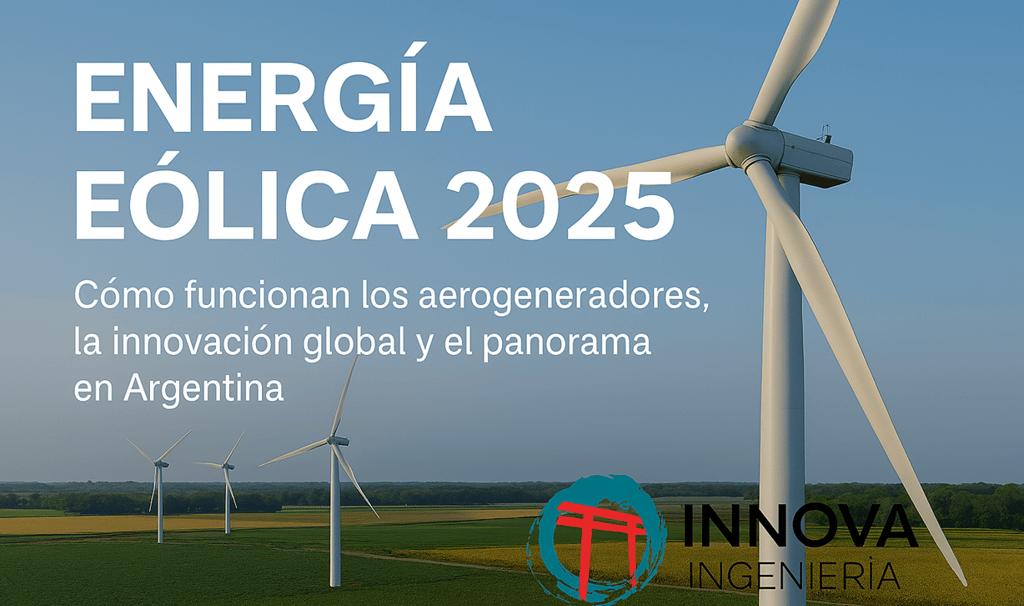
Wind Energy 2025: How Wind Turbines Work, Global Innovation, and the Outlook in Argentina
Summary: Wind energy continues to accelerate its expansion and technological sophistication. In 2024–2025, records are being set in offshore developments, prototypes exceeding 21 MW, more advanced control and aerodynamic strategies, and sustained growth in Argentina with new wind farms and capacity expansions.
1) Operating Principle. From Wind to Electricity
A wind turbine converts the kinetic energy of the wind into electrical energy: the wind rotates the blades (rotor), and the gear/drive, along with the generator, transforms the motion into electricity, which is conditioned and injected into the grid.
The tower provides height to capture more consistent winds and reduce turbulence, while the blades use composite materials and optimized aerodynamic profiles to maximize lift coefficient and minimize drag.
Modern control: control loops regulate pitch (blade angle) and generator torque to optimize energy capture and limit structural loads. Advanced techniques (multivariable control, individual pitch control, LIDAR) are used to improve stability and reduce asymmetric loads.
2) Aerodynamics and Efficiency: Longer Blades, Lower Losses
The trend toward larger scale (bigger rotor and longer blades) improves annual energy production (AEP). Recent studies explore modified NREL airfoils, winglets, and multifidelity optimization to increase performance in large turbines (both onshore and offshore).
In wind farms, layout and wake management (wake steering/yaw control) are critical: typical spacing of 7-15 rotor diameters and optimized yaw control can increase AEP by several percentage points. Iniciatives such as AWAKEN (DOE/NREL) map wake behavior to validate models and strategies.
3) Global Innovation 2024–2025: Offshore Growth and Giant Turbines.
Global Offshore: In 2024 8 GW were added, bringing total installed offshore capacity to 83 GW. The year also set records in auctions (56 GW awarded ) and projects under construction (48 GW), with expected acceleration toward 2030 despite supply chain challenges and unsuccessful auctions in some markets.
Record-breaking turbines:
Siemens Gamesa installed a 21.5 MW prototype 21,5 MW (SG DD‑276) in Denmark, with a ~276 m rotor - currently the most powerful turbine installed in Europe for testing.
Mingyang (China) announced the development of a 22 MW turbine with a rotor exceeding >310 m, designed for high-wind regions and typhoon resistance. Their 2024-2025 roadmap continues the tred toward larger-diameter machines.
4) Argentina Outlook 2025: More Capacity and New Projects
Argentina shows sustained growth in wind energy:
Installed capacity: approximately 4,3 GW (2024) according to IRENA. Wind energy contributed the largest share of renewable generation in the first half of 2025, covering ~18% of national demand with a +17% year -over-year increase in clean energy generation.
New projects and expansions (2025):
YPF Luz – General Lavalle (Buenos Aires): 25 turbines of 6,2 MW each (155 MW), commissioned in April 2025.
Genneia – La Elbita (Buenos Aires): 162 MW (36 turbines), ~US$240 million investment, operational in May 2025.
Arauco III (La Rioja): Phase 3 with 28 turbines, reaching ~250 MW (June 2025).
AES – Vientos Bonaerenses (Bahía Blanca /Tornquist): +102,4 MW expansion over 18 months (US$150 million investment).
Flagship wind farms:
Madryn I+II (Chubut, Genneia): 222 MW, 62 turbines, capacity factors >50% (world-class).
Loma Blanca (Trelew, Goldwind): multiple wind farms (I–III–VI) with 3,2 MW turbines (GW140); strong operational presence and environmental certifications.
La Castellana (Bahía Blanca, Central Puerto): ~99–100 MW with multilateral financing and CAMMESA PPA.
Note: Some sources report ~70 wind farms in operation and over 900 turbines by 2025, across 10 provinces - figures cosistent with observed growth and aggregated IRENA/CAMMESA.
5) Environmental Impact and Mitigation: Noise, Birds, and Bats.
Wind energy is clean and low-carbon, but not environmentally neutral. Key documented risks include bird and bat collisions and habitat disruption.
The most effective mitigation today is curtailment (increasing cut-in wind speed to stop blade rotation during high bat activity periods). A 2014-2024 meta-analysis shows a 33% reduction in mortality per +1 m/s increase in cut-in speed, and approximately -62% average reduction at 5 m/s.
For birds, studies recommend predictive curtailment (radar, cameras, migration models) and micro-siting strategies to reduce risk, with evidence of lower mortality offshore compared to onshore.
6) What's next? Grid Integration and Auctions
Globally, 2025 marks a turning point: there are more auctions and more construction than ever before. However, sustained growth requires policies and auction designs (focused on delivery and risk allocation), along with investment in transmission infrastructure and permitting processes.
Conclusion
Wind energy continues to evolve with larger machines, smarter control systems, and better-designed wind farms.
In Argentina, the 2025 pipeline shows new capacity and expansions that consolidate wind energy as a key pillar of the renewable energy matrix.
The immediate challenge: improving grid integration, ensuring environmental sustainability, and establishing market conditions that allow projects to be executed on time and as planned.
Many of the challenges associated with wind farms—foundations, dynamic loads, and structural behavior—require a deeper engineering assessment beyond standard design assumptions.
If you are involved in these types of projects, you can explore how these challenges are addressed in
structural engineering services for industrial projects
Civil engineering applied to structural and industrial solutions, with a focus on efficiency, durability, and sound engineering judgment.
contact information
DO YOU NEED TECHNICAL SUPPORT FOR YOUR PROJECT?
📧 info@innovaing.net
📞+54 9 11 2334 9347
© 2026 INNOVA Engineering. All rights reserved.
SERVIces
🕒 Monday to Friday · 8:30 AM – 5:30 PM
📍 Buenos Aires (CABA) - Argentina