STRUCTURAL ENGINEERING IN VACA MUERTA | FACILITIES AND ARTIFICIAL LIFT
Structural engineering in Vaca Muerta applied to existing facilities, including expansions, artificial lift systems, vibration analysis, and interventions on structures in operation.
María Eugenia Gambandé
1/17/20262 min read
From Expansion to Fine-Tuning: When the Original Design Is Not the Problem
During early development stages, many facilities were designed for initial operating conditions. However, over time, changes accumulate:
capacity expansions
integration of new equipment
process modifications
new operational requirements
The structure does not fail immediately.
It simply begins to operate under conditions that were never considered in the original design.
And the problem, in most cases, appears later.
Artificial Lift: An Operational Change with Structural Impact
As wells enter decline stages, the implementation of artificial lift systems becomes part of standard operations.
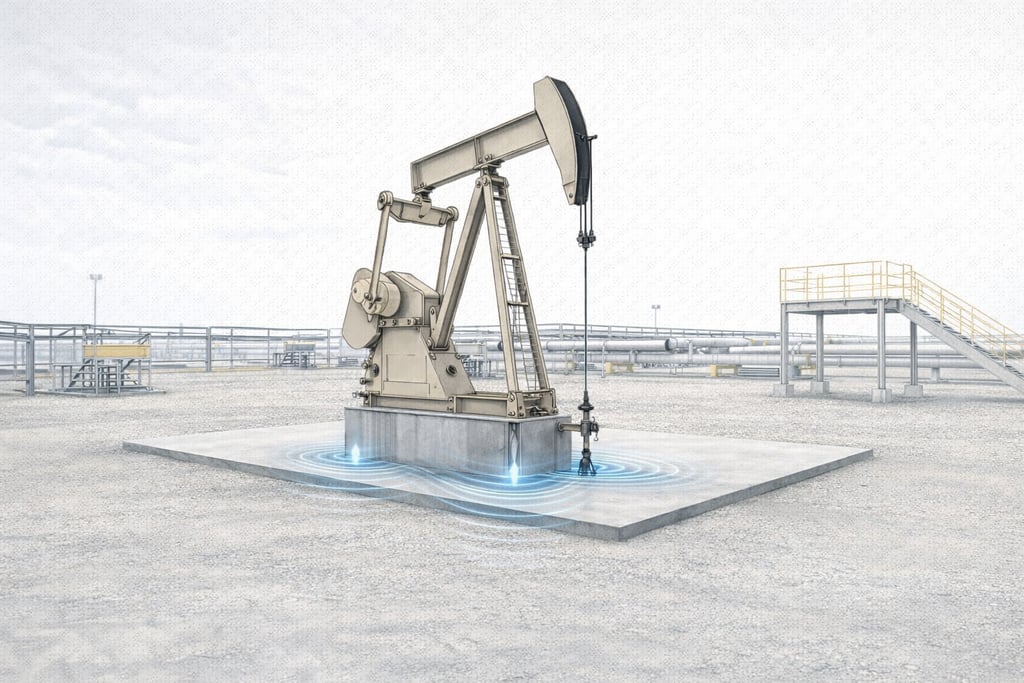
Equipment such as beam pumps (pumpjacks) and associated mechanical systems introduce demands that go far beyond static loads:
dynamic and cyclic loads
continuous vibrations
fatigue effects
soil–structure interaction in existing foundations
Many facilities were not designed to withstand this type of repetitive loading over time.
The challenge is not just installing the equipment, but understanding how this new system interacts with the existing structure.
In many cases, reinforcing “because it vibrates” or adding material without a global assessment can actually worsen the problem instead of solving it.
Small Interventions, Large Consequences
A new platform, additional equipment, or a seemingly minor structural connection.
In existing structures, even a localized intervention can transform independent systems into a single interacting structural system, modifying:
load paths
relative stiffness
displacements
global dynamic response
What is perceived as noise or vibration is often just the visible part of a deeper structural issue.
In structural engineering, adding elements without proper evaluation assumes that the structure will behave the same…
when in reality, it no longer does.
The Value of Engineering Judgment in Operating Facilities
Working in active facilities—especially in environments like Vaca Muerta—requires more than simply applying design codes.
It requires:
structural assessment based on real conditions
models that accurately represent loads and excitations
evaluation of current and future operational scenarios
solutions that prioritize safety, constructability, and efficiency
In many cases, the key is not overdesign, but understanding where and how loads actually act.
Structural engineering in Vaca Muerta is not only about designing new structures, but about supporting the evolution of existing facilities, anticipating issues, and preventing operational decisions from becoming technical risks.
A stable structure is not always a safe structure.
And when problems become visible, it is often too late for simple solutions.
Many of the challenges associated with facilities in Vaca Muerta—especially in mature well stages—are linked to the implementation of artificial lift systems and their interaction with existing structures.
Dynamic loads, vibrations, and fatigue effects are not always considered in the original design, requiring structural evaluation under real operating conditions.
In these contexts, you can see how these situations are addressed in
structural engineering for industrial facilities in operation
Vaca Muerta is currently one of Argentina’s main energy drivers and one of the most relevant unconventional developments worldwide. Its sustained growth does not only involve drilling more wells, but also a continuous evolution of the facilities that support them: capacity expansions, new equipment, operational changes, and structural modifications.
In many cases, these structures were originally designed for very different operating conditions than those required today.
In this context, structural engineering plays a critical role, particularly when working with existing infrastructure under operation.
Civil engineering applied to structural and industrial solutions, with a focus on efficiency, durability, and sound engineering judgment.
contact information
DO YOU NEED TECHNICAL SUPPORT FOR YOUR PROJECT?
📧 info@innovaing.net
📞+54 9 11 2334 9347
© 2026 INNOVA Engineering. All rights reserved.
SERVIces
🕒 Monday to Friday · 8:30 AM – 5:30 PM
📍 Buenos Aires (CABA) - Argentina